
Eddy County Court Calendars Explained
The Fifth Judicial District posts Court Hearing Schedules covering three Eddy County court dockets: District Court, the Carlsbad Magistrate Court, and the Artesia Magistrate Court. Think of these pages as a short-range calendar. They are not the statewide case register. They are not a document image service, and not a full historic docket for Eddy County.
Start with the case record, then turn to the hearing schedule to confirm a near-term setting. Compare the court name, location, case number, date, time, judge or division, and hearing type across both. If the schedule lists no hearing, call the court. If a notice shows a different date, call the court as the final check.
Eddy County Court Dates Window
The Artesia Magistrate hearing schedule shows hearings for the current day plus the next six days. That is a rolling window. There is no party-name field, no custom date picker, or public search button. The page offers no export control either.
The court also warns that hearing details may contain omissions and that it makes no warranty. That warning matters most for a same-day or newly moved setting. Treat the schedule as a starting point. Then contact the court for anything more or for a current confirmation of your Eddy County court date.
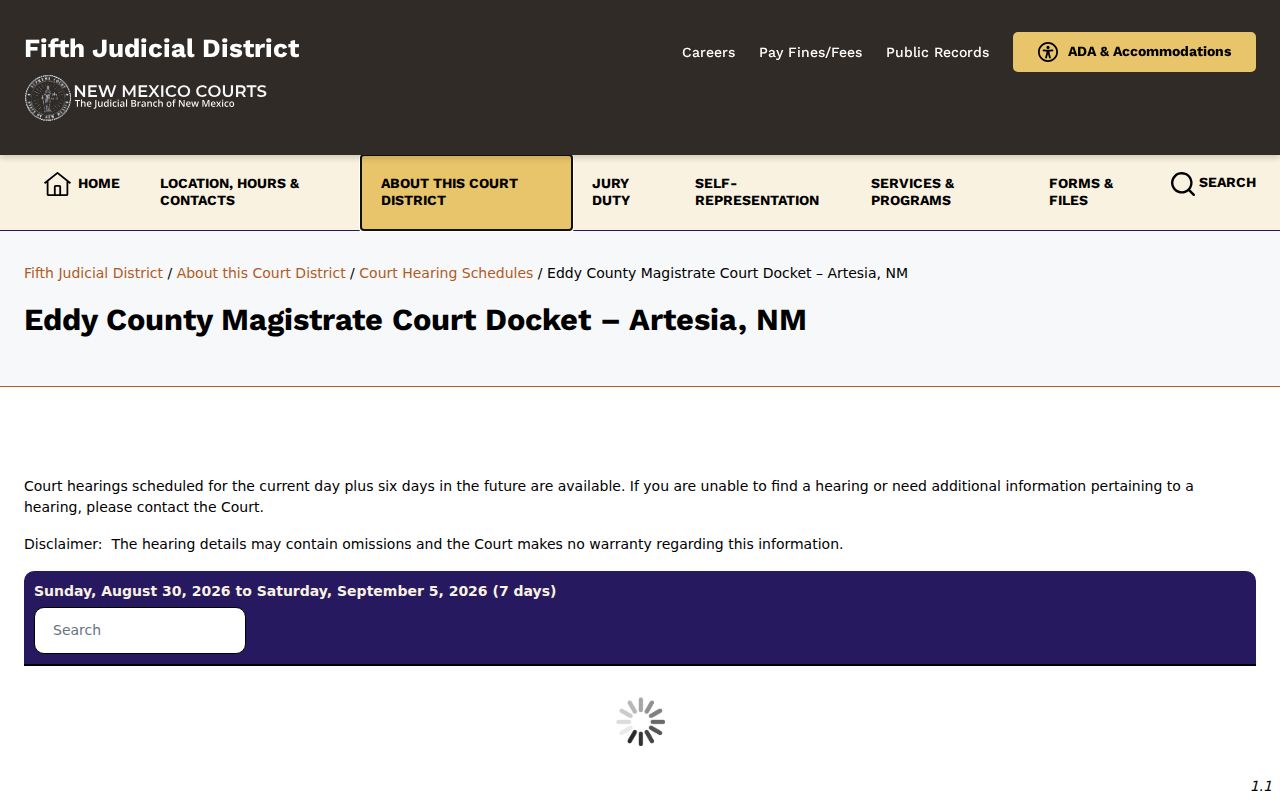
The schedule view shows why an Eddy court date search usually needs both a case number and the right court location. The omission notice tells you to verify. Do not trust the page as the final word. A hearing can be missing, details can change after publication, and the court can hold information outside the public window.
So work from the visible entry, then call. Give the clerk the case number, your party role, and the date in question. Ask whether the listed court and setting still stand.
Finding Your Court Date
Each date channel fills a different need. Case Lookup can show permitted case events. It can also show a setting. The Fifth District schedule can show a near-term District or magistrate hearing. For a party, the written summons, notice, or attorney notice carries the real obligation. When these sources disagree, ask the court about the discrepancy. Rely on its answer.
- Use New Mexico Case Lookup by case number or name and record the court and status.
- Open the matching Fifth District hearing schedule for an Eddy District, Carlsbad Magistrate, or Artesia Magistrate setting.
- Read the court notice, summons, or attorney notice and compare it with the online result.
- Call the correct court clerk or judge or division office if the setting is missing, moved, or unclear.
- Ask at the court counter about the available public access method when an electronic record or posted calendar is needed.
A Fifth District schedule will not always include municipal matters. If your citation came from Carlsbad, Artesia, Loving, or Hope, start with that city's municipal clerk. Check the paperwork first, though. If it names a magistrate court, start there. That court's calendar is the right place to look for your court date.
Eddy County Court Dates Sources
Where does an Eddy County hearing actually show up? Three places. One is the case register, which tracks the chronology of a single case. Another is the Fifth District schedule, a short-range public calendar of upcoming settings. The third is a call to the local clerk, division, or judge's office, which can confirm a setting that changed or never appeared. Used together, the three sources fill each other's gaps.
| Source | Useful for | Limit |
|---|---|---|
| Case Lookup | Case identity, status, and permitted event history. | Not every document or restricted case is shown. |
| Fifth District schedule | Current day through short-range district or magistrate hearings. | Can contain omissions and is not a full register. |
| Clerk or division contact | Confirmation of a missing, moved, or same-day setting. | Needs the correct court and useful case details. |
The statewide schedule index sorts calendars by county and court location. That is no accident. The Fifth Judicial District covers Chaves, Eddy, and Lea Counties. Picking the right court first keeps a calendar result from being mistaken for a match to your case.
Work through the sources in a sensible order. Pull the case register first. It shows the event sequence and the case number. Read the written notice to see whether you must appear. Then check the schedule for the short-range public listing. If the dates or courts disagree, the local clerk or the division contact settles it. That order keeps an Eddy County court-date question anchored to the actual case. It is not a broad calendar search.
How to Read a Court Setting
A setting entry can carry a lot of detail. It may list court name, courtroom or location, judge or division, date, time, case number, case style, hearing type, and sometimes party or attorney information. The setting itself might be an arraignment, a hearing, a pretrial event, a docket call, or a pro se trial. Read it carefully. It is not automatically a trial date or a final disposition.
| Court and location | Identifies the District Court, Carlsbad Magistrate, Artesia Magistrate, or other court that owns the setting. |
|---|---|
| Date and time | The listed hearing point in the public schedule or case register. |
| Case number | The reliable link between a calendar entry and the correct file. |
| Judge or division | May identify the courtroom assignment or division contact. |
| Hearing type | Describes the event, such as arraignment, pretrial, docket call, or hearing. |
A calendar page alone is not a certified notice. The court's written notice controls when an appearance is required, and an update can follow anything posted on a public calendar.
Eddy County Court Dates Jury Reporting
Jury reporting runs on its own Eddy County calendar channel. It sits apart from criminal, civil, and traffic settings. The Eddy District jury page tells summoned jurors to call the code-a-phone. It also says to check online after 5 p.m. Jurors signed up for electronic notice may get email or text instead.
A general hearing schedule is never proof of jury instructions. Follow your summons and the District Court jury channel. If a reporting instruction seems unclear, the jury page lists a court contact path so you can ask.
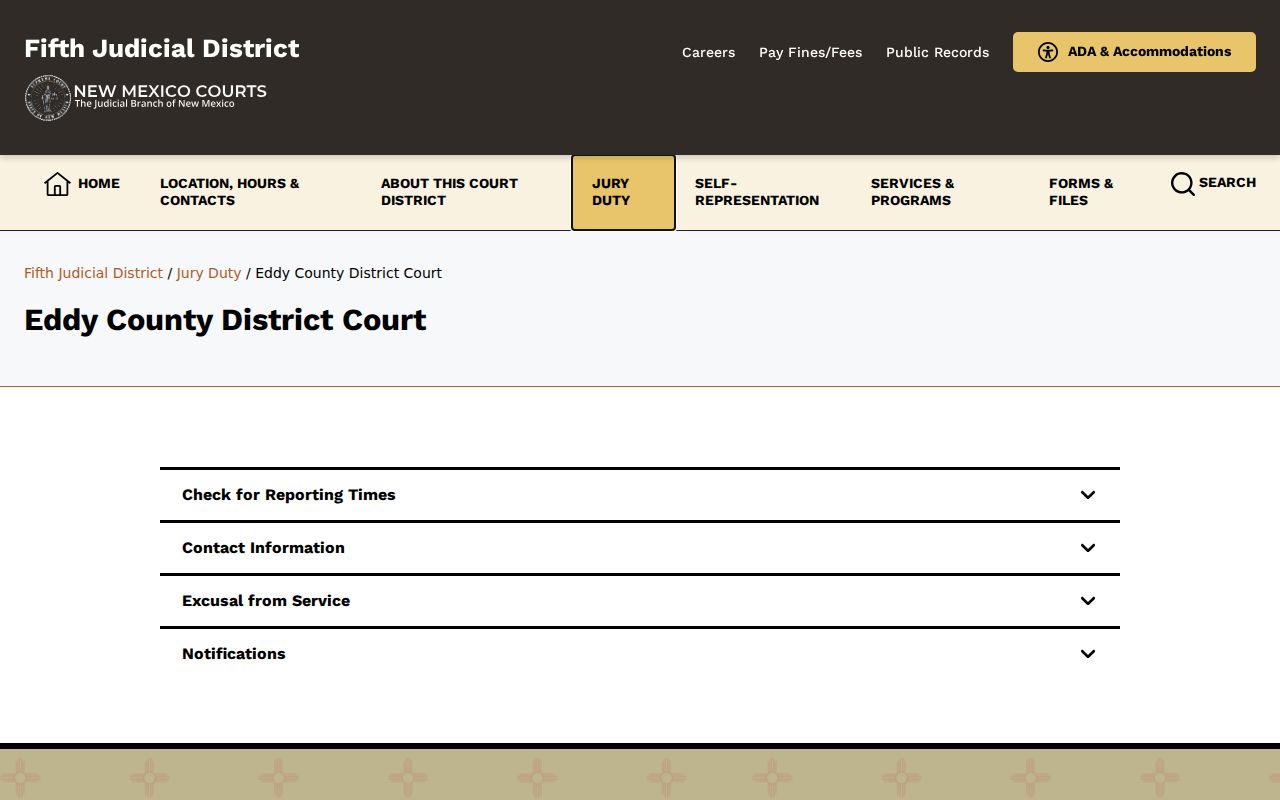
A jury summons and a court hearing are different things. So a docket search should match the kind of appearance you actually have. Do not just match the county name.
Jury reporting answers one question: when must a summoned juror check in. A hearing schedule tells parties when the court will hear a matter. A case docket shows what has been filed and what events are set. The public calendar only reaches a short distance into the future. Use the right source. Then you will not read a jury instruction as a hearing date, or mistake a hearing listing for a jury call.
Continuances, Resets, and Cancellations
Docket entries like "continued," "reset," "vacated," "rescheduled," and "notice of hearing" describe events, not reasons. A reset means the hearing moved. It does not tell you why, and it does not prove every party got notice. Look for a later case event with a replacement date. Then compare the written notice against the current court information.
What if a Fifth District schedule and a mailed notice disagree? Call the clerk or the division office before trusting the web page. The Artesia schedule itself directs visitors to contact the court for missing or additional information. Plan around the counter too. District Court closes from noon to 1 p.m. and cuts off financial work at 4:30 p.m., but neither hour says when a judge is free.
Eddy County Court Dates by Location
There is no single all-purpose Eddy calendar. The district schedule index links the Eddy District Court, Carlsbad Magistrate Court, and Artesia Magistrate Court instead. Carlsbad and Artesia magistrate matters can carry different listings and different clerks. If you hold a court notice, use the court printed on it; do not switch locations just because both cities sit in the same county.
The Eddy District hearing schedule link lives under the Fifth District index, and that index is the stable starting point since paths shift when the court updates its pages. The schedule runs on court-specific navigation rather than a statewide party-name calendar.
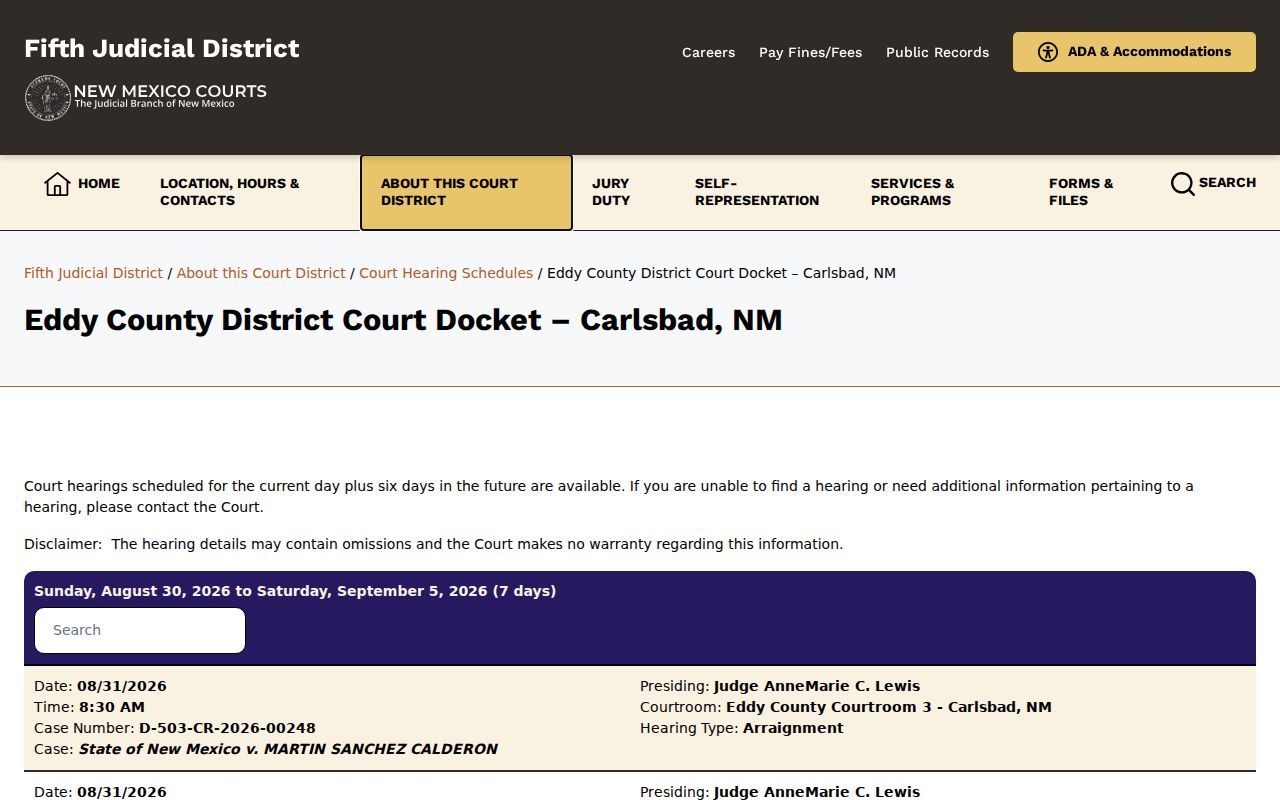
The schedule display is court-specific. Confirm the actual filing location before you rely on any date result from it.
If You Miss a Court Setting
Never assume a missed appearance is excused. Reach the clerk, the judge or division, and your attorney quickly, using the court's official contact path. A case register may show a failure-to-appear, a continuance, or a bench warrant, but only the court can explain the real next step for that case.
Act promptly: A public schedule may be incomplete and a payment receipt is not a substitute for court confirmation. Use the court named on the notice for an absence, warrant, or appearance question.
Traffic and misdemeanor cases come with court-specific payment, appearance, or warrant instructions. For a ticket's date and status, the municipal or magistrate clerk is the right source. A municipal court setting may still require a city court call, even when other Eddy hearings appear online.
Eddy County Court Dates Result Limits
Treat the public schedule as a planning tool. It is not a certified record. It offers no complete historic docket, no document images, and no universal case search. When something falls outside the schedule window, go back to the statewide case lookup. Check your written notice. Call the local court. A courthouse access method should exist under the electronic-record policy, though the exact Eddy terminal or posting location is not published.
A case docket preserves the event sequence. It can reveal a notice of hearing or a continuance. The written notice controls a party's obligation. The schedule is just the short-range public view. When these sources conflict, hand the correct clerk or division your case number and the date question. The court can verify whether a listed setting is still active or has since changed.
Note: a court date can change after a public calendar was posted. Reconcile the docket, the written notice, and a call to the court. Do that before you travel or make an appearance decision.