
Getting Eddy County Court Records
Check the paperwork first. The citation, summons, judgment, or notice in hand usually names the court that took the case. That tells you where the record lives. For electronic case information, the New Mexico Case Lookup lets you search by name or case number. It also covers court location, category, status, and filing date. It will not hand you document images. So once the case turns up, be precise with the clerk. Give the court, case number, year, parties or caption, the document title and date. Say whether you want a plain, certified, or exemplified copy. Detail like that lets the clerk pull an existing record instead of guessing.
Each level of court keeps its own files. Eddy County District Court cases go to the District Court Clerk’s Office. A Carlsbad or Artesia magistrate file stays with that magistrate clerk. Municipal citations stay with the issuing city or village court. The Eddy County Clerk handles recording, election, marriage-license, and similar county records. Judicial case files are not part of that office. When nothing appears online, the record may simply be old, restricted by access rules, or filed elsewhere.
- Use the case number or the party and court details to identify the filing court and the document sought.
- Check Case Lookup for current case information, then save the case number, court location, case type, and document title.
- Ask the correct clerk by phone, email, mail, or at the counter whether the unsealed file can be inspected and how to submit the copy request.
- State whether a plain, certified, exemplified, emailed, mailed, or audio copy is needed before asking about the current charge.
- Confirm the fee, payment method, delivery method, and any retrieval time for a microfilm or archived file.
Note: A payment receipt or a public lookup result confirms only limited information. Neither one stands in for a clerk-issued copy of the court record.
Eddy County Court Record Custodians
Custodianship is the first question in Eddy County. The Fifth Judicial District sits in Carlsbad. Yet the magistrate and municipal courts run their own registers. Felonies, civil matters, domestic-relations cases, juvenile cases, probate-related district filings, and appeals from lower courts all live in District Court records. Carlsburg and Artesia Magistrate Courts hold limited civil, misdemeanor, DWI, traffic, and felony preliminary-hearing files for their own venues. A city citation never becomes a District Court record. It does not matter that it arose in Eddy County.
| Record sought | First court custodian | Why the routing matters |
|---|---|---|
| Felony, divorce, district civil, or district appeal | Eddy County District Court Clerk | The District Court keeps the case register and file. |
| Carlsbad or Artesia traffic, DWI, misdemeanor, or limited civil | The named Magistrate Court clerk | Magistrate records are separate from the district file. |
| City ordinance or municipal citation | The named municipal court clerk | Municipal courts keep local dockets and payment records. |
| Deed, lien, marriage, or election record | Eddy County Clerk | That is a county record, not a judicial case file. |
Did a felony begin with a preliminary hearing? Ask for both court numbers. Each court may hold its own entries. The Fifth Judicial District contact directory gives the local court locations and contacts you need to tell the two apart.
Court Record Types
A case file holds more than the docket shows online. Under Rule 1-079, the register of actions and docket entries count as court records. Papers, exhibits, transcripts, and anything else filed or lodged with the court count too. What is actually inside depends on the case and on access limits. A civil matter may hold pleadings and signed orders. A criminal file can hold charging documents and hearing notices. It can also hold motions, judgments, and sentencing papers.
- Case cover or summary information and the register of actions.
- Complaints, petitions, answers, amended pleadings, and service papers.
- Motions, responses, proposed orders, and signed court orders.
- Judgments, decrees, sentencing documents, and appeal notices.
- Exhibits, affidavits, transcripts, and releasable hearing audio when retained.
- Financial entries for filing fees, bonds, fines, costs, or judgments when available in the case file.
Case Lookup helps with case history, but it does not display public document images, and it will not guarantee a current balance. Name the exact item. A judgment, order, hearing recording, citation, or docket register gives the clerk a workable target.
Older Eddy County Court Records
Old files follow a different path. The Fifth Judicial District notes that files older than five years may sit on microfilm. Judiciary Case Lookup help treats records before 1997 as ones requiring an online request. Neither notice proves a paper file is gone. Retrieval, not existence, is the real issue. Ask the clerk whether the document sits in the active file, on microfilm, or in another archived format. Ask as well whether copying needs extra time.
For a historical request, supply the filing year, the court, caption or party names, the case number if known, and the precise item. Staff can pull an existing docket, order, calendar, or pleading far more easily than they can build a new case history from scratch. Genealogical researchers should also separate a probate court register from a District Court file whenever an estate turned contested.
Practical point: An older Eddy County case may need clerk retrieval even when the public electronic search returns no record. Ask whether microfilm or a pre-1997 request path applies.
Inside an Eddy County Court Record
Case information usually opens with the identifier and court location. From there it links parties, case category, filings, hearings, and disposition. The public result may show only part of it. Registered re:SearchNM users can see more Odyssey case information and documents. Access is role-based. It is not an open public archive. When you need an official document, a clerk copy request is the better route.
| Case number | The court’s identifier, filing year, and linked court location. Preserve it exactly as shown. |
|---|---|
| Case status | Open, closed, or another current status. A status does not itself explain every filing. |
| Register of actions | Chronological docket entries that record filings, notices, settings, and court activity. |
| Hearing details | Date, time, court or division, and setting type when public access permits display. |
| Orders and judgments | Signed rulings, decrees, or sentencing documents requested by title and date. |
| Protected material | Redacted identifiers or restricted documents that cannot be released as an ordinary public copy. |
A docket entry saying a motion was filed is not the motion itself. The same goes for hearings. An entry never replaces the notice or recording. State the product you want. Ask whether it is available for inspection, ordinary copying, certification, or another authorized form.
Specific Eddy County Record Requests
New Mexico's judiciary runs one statewide IPRA request form for record requests. The form asks where the case sits and which court or department handled it. It also covers how to reach you, who the record concerns, the record type, the case number, and a plain description of what you want. Filing it there does not hand your Eddy County case file to the Administrative Office of the Courts, though. That office just routes paper. Pick the Fifth Judicial District, or the specific court where the case was actually filed. List only the identifiers that truly narrow things down.
A strong request gets to the point fast. Give the case number, the year, the case type, the party or caption, the document's title and date, and whether you want copies. Asking for the whole file can drag. One judgment or a single hearing record would often settle the matter. New Mexico's IPRA framework never demands a reason to inspect. It does demand reasonable particularity. When a request can't be filled within three business days, the custodian must send written timing information. The response is due no later than fifteen days.
One caution: leave out Social Security numbers, financial-account numbers, and extra personal details. A case number plus a document description usually identifies the record just fine.
The judiciary's own IPRA form shows its fields for court location and the particular record you're after. You can see the layout before filling anything in.
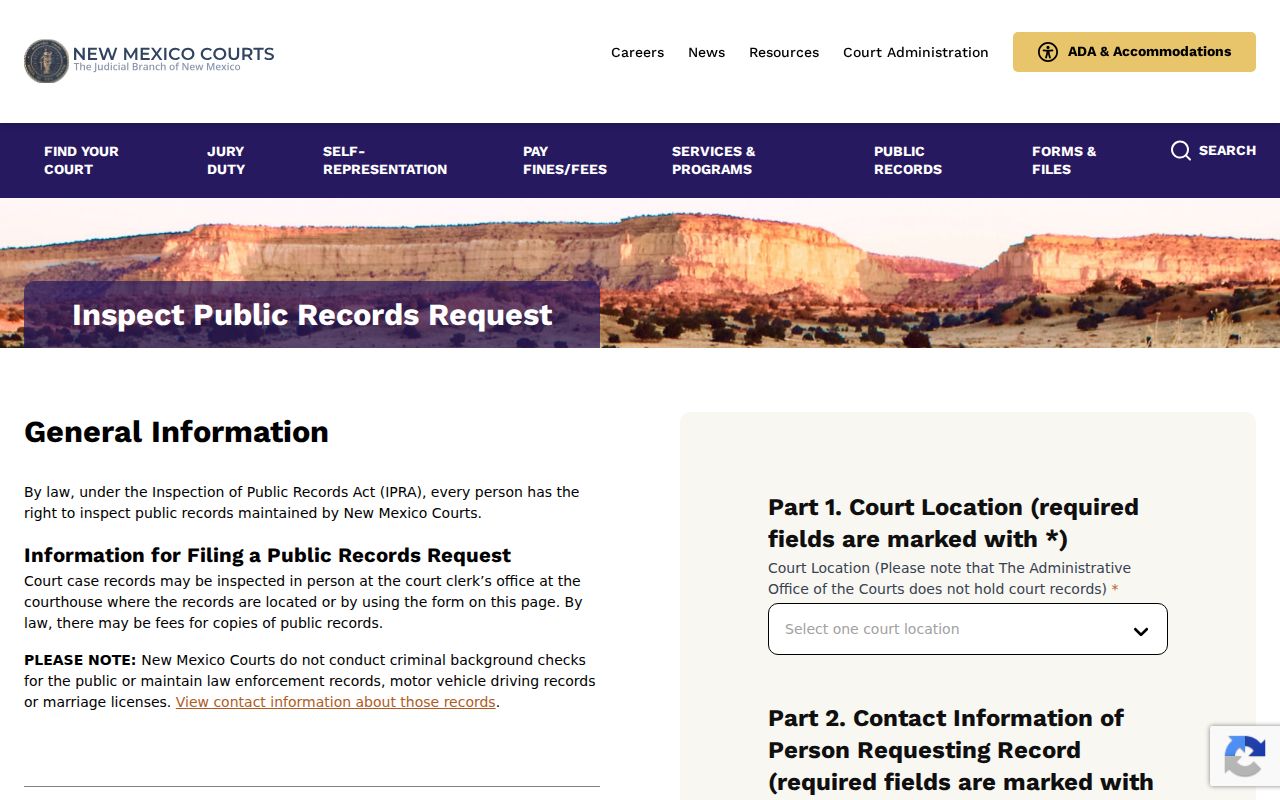
Nailing down which court holds the file comes first, since every request field here, from location to description, points back to that one local custodian.
Fees and Certified Copies
What kind of copy do you need? A plain copy just reproduces the page. A certified copy adds the clerk's certification. An exemplified copy carries an even higher level of authentication for use out of state. The Fifth Judicial District publishes no separate Eddy fee schedule. So treat the figures below as state and district benchmarks rather than a promise of what you will owe. Before mailing any money, confirm the current Eddy Court charge and the accepted payment method. Ask whether mail delivery requires a self-addressed stamped envelope too.
| Requested item | Current benchmark |
|---|---|
| Plain photocopy | $0.35 per page |
| Certified copy | $0.35 per page plus $1.50 certification per document |
| Exemplified copy | $0.35 per page plus $4.50 exemplification per document |
| CD or audio duplication | $4 per CD |
| Emailed copy | No charge in the state sample form |
Eddy County District Court Clerk’s Office
102 N. Canal St., Suite 240
Carlsbad, NM 88220
575-885-4740
For district copies, inspection, and records questions, the District Court counter is the local route. A magistrate or municipal matter works differently. Take that request to the clerk of the named court rather than mailing it to District Court.
Eddy County Electronic Record Channels
Eddy County offers more than one electronic path, and each serves a different purpose. Case Lookup is the public tool that needs no registration. It can return case identity, parties, status, and permitted docket information, though not document images. Registered users of re:SearchNM get more Odyssey case information plus documents, if they are qualifying attorneys, justice partners, press users, or self-represented parties who meet the access rules. Neither product substitutes for a clerk-issued certified copy.
| Channel | Use for an Eddy County request | Limit |
|---|---|---|
| Public Case Lookup | Locate current electronic case information and identify the court. | No public document images; restricted and municipal data limits apply. |
| Registered re:SearchNM | Role-based Odyssey access for a qualifying user. | Registration and user-tier rules limit access. |
| Clerk counter or request | Inspect an unsealed file or obtain a requested court copy. | The correct court custodian must be contacted. |
| Judiciary IPRA form | Send a written request with court location and a specific record description. | AOC does not hold the local Eddy case file. |
Odyssey File & Serve is a separate channel, and it serves a different purpose. This system handles electronic filing and service for the courts, not public lookups. If you receive an e-filing fee or acceptance notice, treat it as what it is. It is not a copy fee. It is not a docket result, and not an authenticated Eddy County court record.
Sealed Records and Public Access
New Mexico court records start from a presumption of public access. That does not mean everything is open online or free of redactions. Sealing orders, statutory confidentiality, and rule-based restrictions all exist. Each can limit what a person may inspect or copy. Some personal identifiers are protected by rule. These include all but the last four digits of Social Security numbers. Taxpayer-identification numbers, financial-account numbers, and driver-license numbers are covered too, plus all but the year of a birth date.
Key Rules:
Rule 1-079 NMRA presumes public access, defines court records, and governs protected identifiers and sealing.
NMSA 1978 §14-2-8 requires a reasonably particular public-record request and sets the response framework.
New Mexico’s electronic-record order requires a no-charge courthouse means of electronic access while allowing standard print charges.
Not every case shows up in a public search. Juvenile criminal matters, some protection-order cases, restricted tiers, and sealed files exist. Any of them may be absent from the Eddy County court docket results. So a blank result proves nothing about whether a case existed. Start with the Eddy County case lookup path. It confirms the case identity and court location. Then ask the clerk directly whether the record is restricted, archived, not digitized, or held by another court.
Inspecting Eddy County Court Files
Unsealed files are read at the court where they live, with staff present. The statewide electronic-record policy requires a free courthouse means of electronic access. Fifth District does not publish a separate Eddy County terminal location. Call the clerk before you travel. Ask which desk holds the file, whether it sits on microfilm, and whether a copy request needs a particular device or payment method. District Court public hours run Monday through Friday, 8 a.m. to noon and 1 p.m. to 5 p.m. Financial transactions stop after 4:30 p.m. Those hours help you plan a records visit. They do not promise that a file will be ready the moment you arrive. Court access rules may also limit recording-capable devices. Staff can walk you through local procedures or an accommodation request before you come.